
Fleece
A napped polyester that traps air: light, warm and quick to dry — with real trade-offs worth knowing.
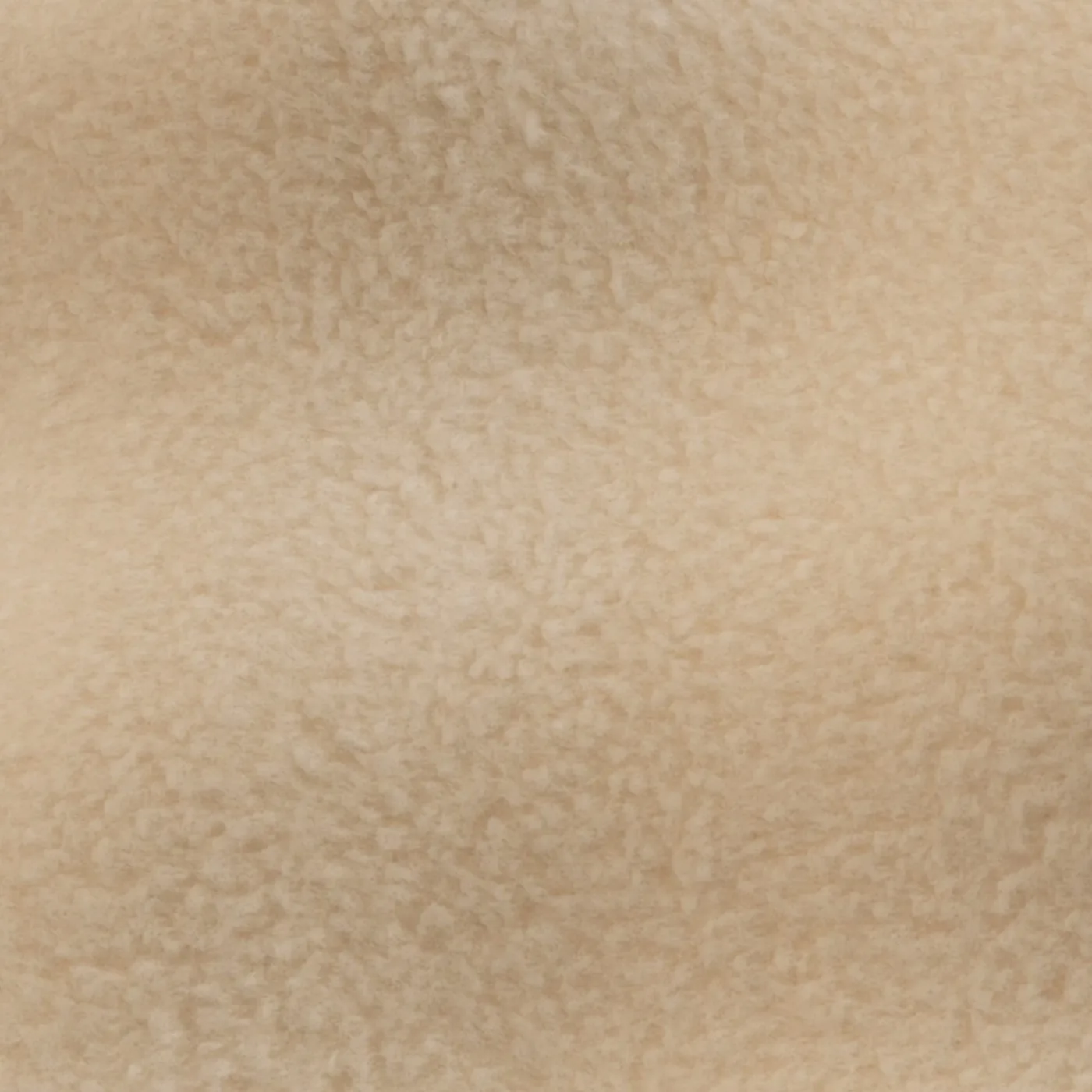 Drag to stretch
Quick facts
- Fibre
- Polyester, often from recycled PET bottles
- Construction
- Napped (brushed) pile fabric
- Stretch
- Some
- Drape
- Soft and lofty
- Moisture
- Holds under 1% of its weight in water; dries in 1–4 hours
- Typical weight
- 100–300 GSM — what GSM means
What it is
Polar fleece is an insulating, napped polyester fabric — its surface is raised into a soft pile. It can be made from recycled PET bottles or recycled fleece [1].
A note on names: in hoodies and sweatshirts, “fleece” often means something different — a cotton or cotton-blend knit with a brushed inner side. This page is about polar fleece.
Why it’s warm
The raised pile traps air, and trapped air is what insulates. Fleece is sold by weight — micro, 100, 200 and 300 grams per square metre — and heavier, higher-loft grades are warmer [1].
How it behaves in the wet
Polyester is hydrophobic. When wet, fleece holds less than 1% of its weight in water and dries in about one to four hours [1]. But it is not waterproof or windproof, and it loses most of its insulation once it’s wet [1] — so in rain it needs a shell over it.
The trade-offs
- Static and pilling. Fleece builds static that picks up lint, dust and pet hair, and lower-quality fleece pills [1].
- Microfibres. Washing synthetic fleece releases tiny plastic fibres. One study measured up to about 2 grams per garment per wash, with top-loading machines releasing about seven times more than front-loaders, and mechanically aged garments shedding more than new ones [2].
A bit of history
An early version, Synchilla, was developed by Malden Mills with Patagonia in Massachusetts in 1979. Malden Mills chose not to patent it, which helped it spread quickly [1].
Sources
- Polar fleece — Wikipedia
- Hartline et al. (2016), Microfiber Masses Recovered from Conventional Machine Washing of New or Aged Garments — Environmental Science & Technology
Written by the Vibe Studio. Last updated .